

Polyanna CLI Alerts With OpenClaw

The first Polyanna post covered the basic Polymarket copy-trading problem: the public data exists, but it is not instantly useful. There is latency in seeing a trader's fill, latency in deciding whether the move still has edge, and latency in placing your own order. In thin Polymarket books, that delay is where a lot of copy-trading ideas die.
Automation is needed to address this issue, and Polyanna is a strong fit for that workflow: Polyanna leaderboards and trader analytics tell you who is worth watching, the Polyanna CLI manages watchlist traders and streams authenticated live alerts, then OpenClaw decides whether and how to trade.
OpenClaw Setup
Running OpenClaw on your own computer is free, but it is not reliable for an always-on alert executor. A small VPS is the cleaner default; Hostinger has a one-click OpenClaw VPS at about $6.50/month at the time of writing. Hostinger did not fund or sponsor this; it is just a concrete reference point.
The official OpenClaw Docker docs cover the gateway flow, provider-key onboarding, health checks, and persistence. Before wiring anything to real trading, confirm the gateway is running, the dashboard is reachable, and the health endpoint or equivalent probe is green. Do not make the first end-to-end test a live order.
Install Polyanna CLI
Install the Polyanna CLI on the same machine that runs OpenClaw, upgrade to the latest version, and log in. You need a Pro account to enable watchlist alerts, but you can discover traders and leaderboards with a free account. Login stores a Polyanna credential with the same access as your account tier.
/bin/sh -c "$(curl -fsSL https://polyanna.app/install-cli.sh)"
polyanna upgrade
polyanna login
The CLI is intentionally narrow: discovery, trader analytics, alert watchlist traders, and live alert streaming. That is enough for a copy-trading agent.
Choose Who To Watch
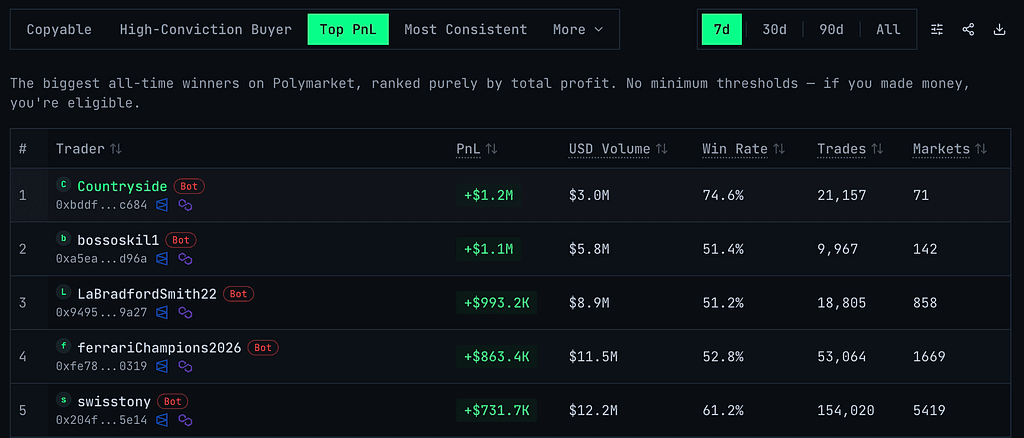
Start with copy-trading focused leaderboards, not individual wallet lore. Inspect lists such as Copyable and High-Conviction Buyer first because those traders tend to operate in markets that are less volatile and less sensitive to a few seconds of latency.
# See available leaderboard names
polyanna leaderboard list
# Inspect the top 10 Copyable traders
polyanna leaderboard get copyable --limit 10
# Inspect the top 10 High-Conviction Buyer traders
polyanna leaderboard get conviction --limit 10
# Find a trader by username
polyanna trader search --query <name>
# Review one trader's analytics
polyanna trader analytics <name-or-address>
The point is not to blindly mirror the first ten names. Use analytics to filter for traders whose behavior can actually be copied: markets with enough liquidity, fill sizes that fit your capital, manageable drawdowns, and a strategy you can explain without hand waving.
Add Watchlist Alerts
Once you have candidates, add watchlist traders for CLI alerts. A leaderboard command snapshots the current top traders from that leaderboard; a trader command pins one username or wallet address.
polyanna alert sub --leaderboard copyable --top 10 # Add the top 10 Copyable leaderboard traders
polyanna alert sub --leaderboard conviction --top 10 # Add the top 10 High-Conviction Buyer traders
polyanna alert sub --trader <name-or-address> --label "manual pick" # Add one trader by name or address
polyanna alert list # List saved watchlist traders
polyanna alert status # Check CLI watchlist alert status
polyanna alert watch # Stream live alerts
Trade alerts are delivered through Polyanna's hosted alert channel. The CLI command adds watchlist traders and enables CLI alert delivery; the alerts start streaming only when you run the watcher.
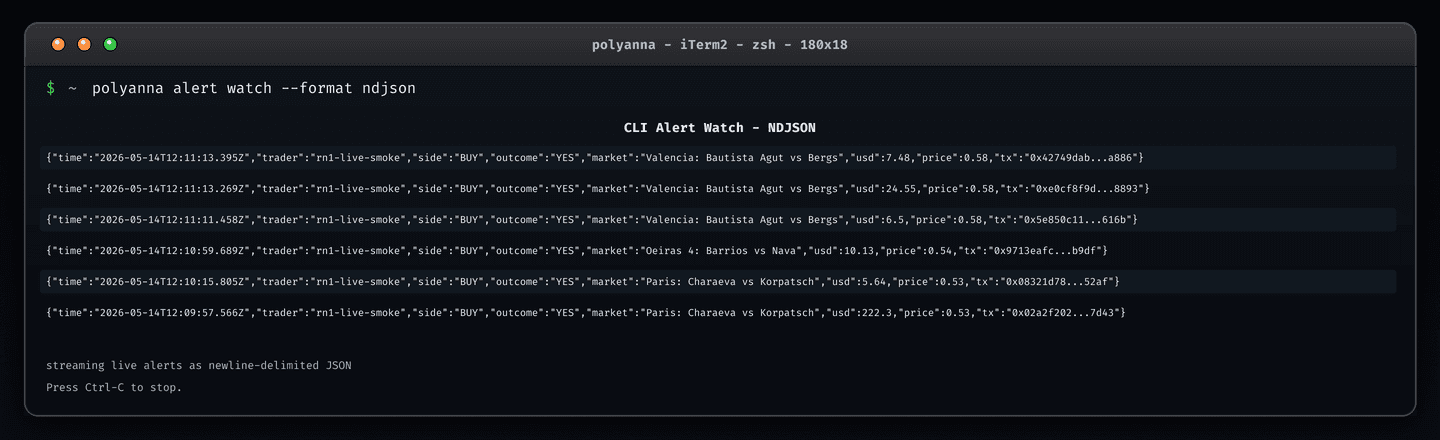
Under the hood, those CLI alerts come from on-chain transaction tracking. Polyanna watches filled-order activity for watchlist trader addresses, enriches the matching fills, and then pushes the resulting alert through the live CLI channel.
Handoff To OpenClaw
Put a small adapter between Polyanna and the execution backend. The CLI opens Polyanna's authenticated /notifications/live websocket, then the adapter reads live alerts from stdin, deduplicates by id, applies risk rules, and passes a structured task to OpenClaw. OpenClaw can orchestrate the action; the adapter keeps the same alert validation, sizing, and duplicate protection in front of it.
polyanna alert watch --format ndjson | node polyanna-executor-adapter.mjsimport { createInterface } from "node:readline/promises";
const rl = createInterface({ input: process.stdin });
const seen = new Set();
for await (const line of rl) {
const alert = JSON.parse(line);
if (seen.has(alert.id)) continue;
seen.add(alert.id);
if (!passesRiskRules(alert)) continue;
await dispatchToExecutor({
source: "polyanna",
alert_id: alert.id,
market_id: alert.market_id,
asset_id: alert.asset_id,
direction: alert.direction,
reference_price: alert.price,
max_usd: sizeFromPolicy(alert)
});
}Keep the task you hand to the executor explicit: market, asset, direction, reference price, maximum size, slippage ceiling, and why the alert passed policy. The agent can reason about execution, but it should not be allowed to invent risk limits at runtime.
Risk Controls
The safety work is part of the product, not a footnote. Before any live execution, require:
- Paper trading mode that records the exact order it would have placed.
- Slippage checks against the current order book, so the adapter can reject an order if the expected fill price has moved too far from the alert price.
- Structured logs for alert, decision, quote, order, and fill.
There is also a legal boundary. Check the Polymarket Terms of Service and your jurisdiction before you trade. The Polymarket Agents README notes that US persons and people in certain jurisdictions are restricted from trading on Polymarket through the UI, API, and agents, while data remains viewable globally.
Closing
Polyanna lets you discover traders and stream live trade signals using purpose-built leaderboards, trader analytics, and CLI watchlist alerts. You choose who is worth watching in Polyanna, then keep a stable live alert stream available for downstream tools.
That means you can swap the execution backend without changing the signal source. OpenClaw can orchestrate the action, and the Polyanna CLI can keep doing the narrow job it is built for: authenticated live Polymarket trade alerts.