

Polyanna: The Analytics Platform for Polymarket

Over the last few months, my friend Beeblebrox and I have been building Polyanna: an analytics platform focused on Polymarket for tracking top traders, inspecting wallets, and finding winning strategies.
Polymarket is the most popular prediction market. It has around 2.6 million active users as of May 2026. Total volume is around 62 billion dollars, and winning users have profited by a total of 1.16 billion dollars. User activity has accelerated sharply in recent months, as the filled order chart below shows.
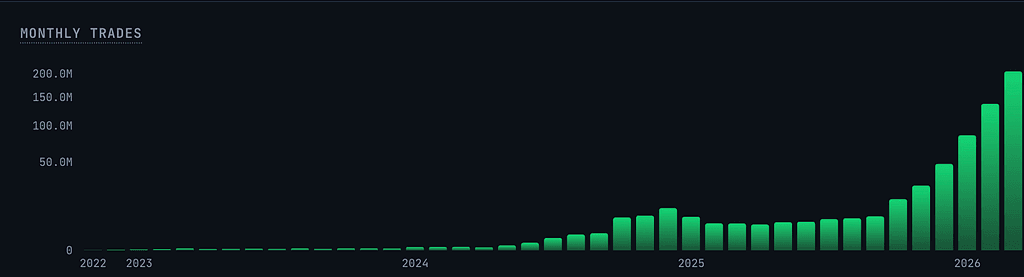
That scale has made Polymarket's public trading data more valuable, but also harder to use. The recent attention has brought reports about insiders and people earning through copy trading. We got on board quickly, but copy trading proved more complicated than it looks from the outside.
There is latency in tracking a copied trader's fills and latency in executing your own market orders. That gap creates slippage, especially in thin and volatile markets where a few cents can erase the edge. Many of the most profitable users are automated systems that place thousands of orders a day inside narrow opportunity windows. Others are whales who make large investments on almost-certain outcomes and wait for resolution.
Capturing those opportunities requires precise intelligence. Public data is available, but data at this scale is not useful by itself. Hundreds of millions of trades are too many to inspect manually. Even when you look at a single trader, raw trades do not immediately tell you whether the trader is skilled, lucky, automated, overfit to one category, or taking painful drawdowns.
So we built Polyanna for ourselves and for people who want dependable analysis instead of another raw activity feed.
Polyanna
The name is inspired by Eleanor H. Porter's novel Pollyanna. Like the character, we are trying to stay optimistic about finding the good side of every situation, in this case by uncovering smart strategies on Polymarket.
Polyanna is built on all historical filled-order entries since the start of Polymarket's CLOB. We enrich those fills with market metadata and other sources, then compute analytics from that indexed history. The pipeline runs periodically every few hours, and each cycle verifies displayed data against known ground truths such as the Polymarket API.
The platform focuses on accurate, in-depth, and readable analysis for finding strategies across copy trading and pricing imbalances. That led us to three core surfaces: one for finding traders, one for tracking large moves, and one for spotting market-level signals.
Leaderboards
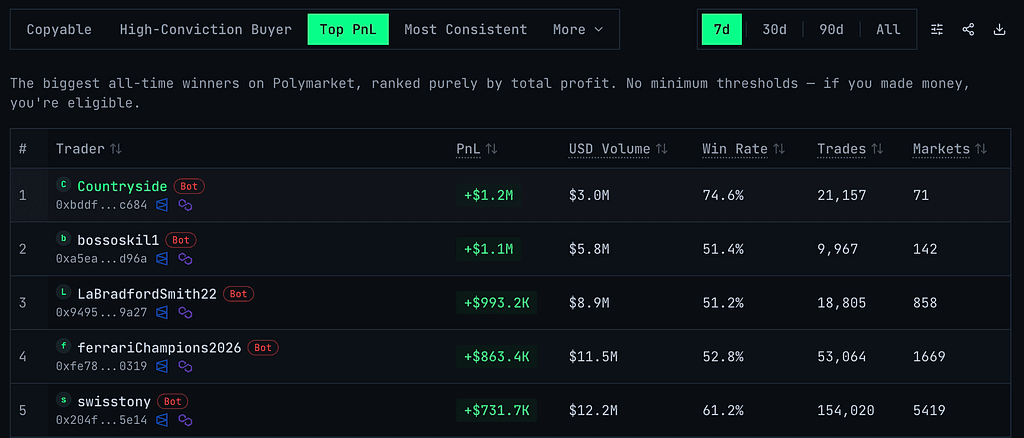
The first question is who is worth studying. The most important surface in Polyanna is the Leaderboards: curated lists designed to show top traders and profitable traders whose moves may be easier to replicate, especially wallets trading liquid markets with high conviction rates.
Whale Radar
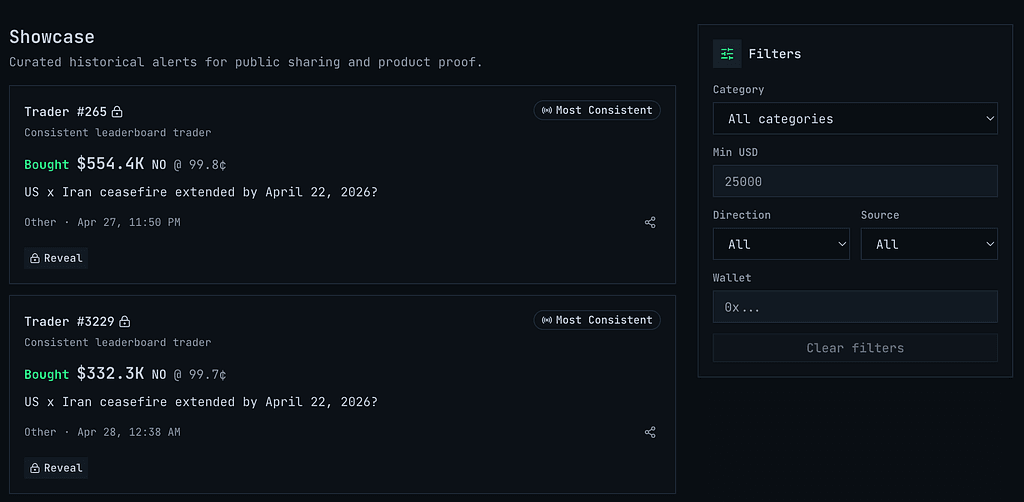
Once you know who is performing well, the next question is where large capital is moving. Whale Radar is a feed of recent high-volume moves by large traders. These users put meaningful capital behind outcomes they believe are likely to happen or likely to appreciate.
Smart-Money Signals
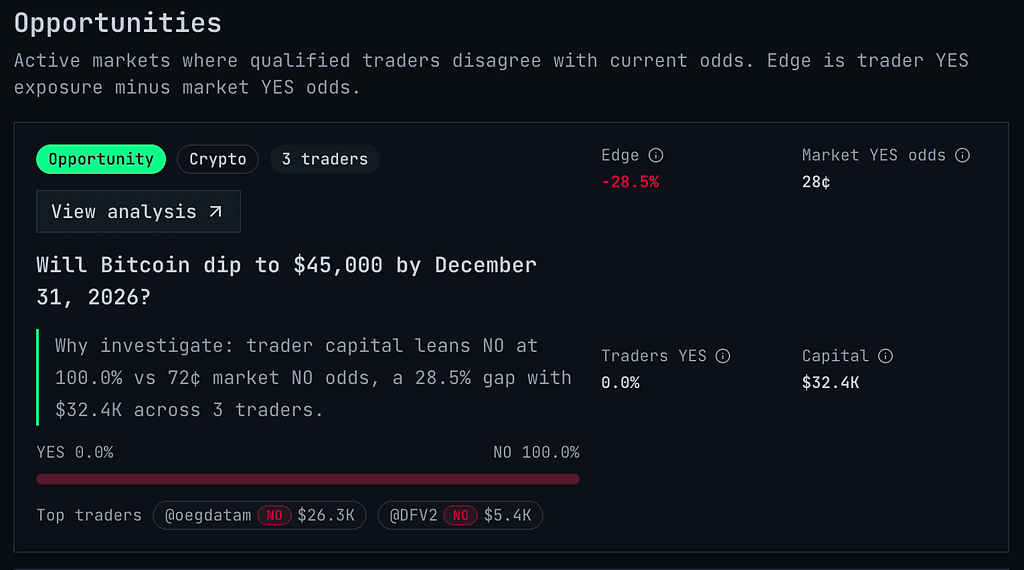
The third surface moves from wallet-level analysis to market-level opportunity. Smart-Money Signals help find active markets where cohorts of strong traders are taking meaningful positions. They show where those traders agree or disagree with current odds and highlight market-level opportunities that are hard to see from raw activity alone.
Across these surfaces, signed-in users can export data as CSV files. Programmatic access is available through the Polyanna API, so automations can discover who to follow, track whale activity, and use the same Smart-Money Signals. Pro users can also enable alerts on favorite traders and receive updates through Telegram, email, or webhook.
Conclusion
We are officially launching Polyanna this week. We are still early, and there is a lot to improve, but the goal is simple: make Polymarket's public data easier to interpret, faster to act on, and more useful for finding real edges.
Reach out through the green chatbox on the homepage if you see a bug or have complaints, suggestions, or feature requests.
Thanks for reading.